

What is Toyota Water Pump?
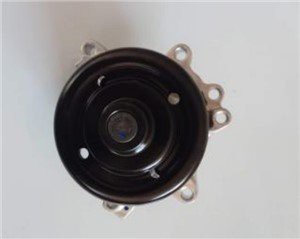
The toyota water pump is a machine that transforms electrical energy into hydraulic power by transmitting it to water. It is this energy that causes the movement of the water itself. Each pump is made up of two main elements: The hydraulic part and the electric motor. The support is used to fix the pump to the base. Based on these characteristics, toyota water pump can be used to lift water from a lower level to a higher level by pushing and are used both for civil and domestic use as well as for industrial use.
Advantages of Toyota Water Pump
Energy saving
Water pumps can transport water from low places to high places, thereby solving water problems and saving energy. For water needs in industry, agriculture and other fields, the use of water pumps can save energy, improve work efficiency, and reduce energy waste and environmental pollution.
Increase productivity
The use of water pumps can effectively improve the production efficiency of various industries. For example, in industrial production, water pumps are one of the indispensable equipment. The water pump can transport cooling water to the equipment that needs to be cooled during the production process to reduce the temperature of the equipment, ensure the stability of production, and improve production efficiency.
Stable quality
The stability and reliability of water pumps are of great concern to users. The water pump uses advanced technology and manufacturing processes to ensure the quality and stability of the product. At the same time, the operation of the water pump also requires regular maintenance and upkeep to ensure its long-term stability and reliability.
Easy to use
The water pump is simple to operate and easy to maintain and maintain. Users can operate according to the water pump instruction manual to ensure the normal operation of the water pump,the maintenance of the water pump is also very simple.
-

Toyota Coralla 1.8 2008-2015 Water Pump 16100-39465 16100...
Contents: Water Pump, Rubber Seal Ring. Drive Style: Accessory Belt. Housing Material: Aluminum. Impeller Material: Iron Add to Inquiry -
Toyota Camry 2.4 2006-2015 Water Pump 16100-0H040
• 100% factory tested for leakage and dimensional precision. • Designed to match OE coolant flow rate and pressure. • Bearings are noise and durability tested Add to Inquiry -
Toyota Camry 2.4 2006-2013 Water Pump 16100-28040 16100-2...
Housing Material: Aluminum. Impeller Material: Iron. Pulley Included: No. OEM Part Number(s): 16100-28040 16100-28041 Add to Inquiry -
Toyota Coralla 1999-2012 Water Pump 16100-09080 16100-294...
• Corrosion resistant cast iron or aluminum body construction to provide extra strength and long lasting durability. • Engineered with precision to meet or exceed OE specifications. • Pre-tested to Add to Inquiry -
Toyota Vios 2000-2014 Water Pump 16100-29155 16100-29195 ...
• Heavy duty bearings, sealed and lubed for life. • Includes all necessary gaskets and seals needed for a complete installation. • Where applicable, metal and resin impellers are offered Add to Inquiry -
Toyota Prado 4000 1997-2015 Water Pump 16100-39405 16100...
● Superior quality matching Japanese products.. ● Using good raw materials. ● All the products have passed the quality, precision and durability tests. Add to Inquiry




Why Choose Us
Our factory
Our is a factory specializing in the production of automobile fan motor, fan assemblies and distributors etc,because of the optimization of the technological process, we have lower production costs while taking into account the quality.
Professional team
We are in line with the concept of one-stop service, quality is priority, customer is the first,our professional technical r & d team who have more than 30 years field experience provides technical support throughout the process.
High quality
Our business is to sell the products manufactured by the factory abroad,the biggest advantage of our products is long service life and high performance-to-price ratio.
Online service
Customers learn about our products and send us inquiries through online and offline channels. We will respond to your needs as soon as possible and give you the greatest support.
Types of Toyota Water Pump
Automotive water pumps
Automotive water pumps are impeller pumps that are used in the engines of cars, trucks, and other vehicles to circulate cooling fluid within the water jacket of combustion engines. These pumps serve to move cooling fluid through a closed system so that the engine does not overheat and to pump the circulating fluid to a radiator that drops the coolant temperature bypassing the heat to the air. While known colloquially as water pumps, the cooling fluid used in automotive engines is a mixture of water with a glycol-based product that raises the boiling point and lowers the freezing point of the fluid.
Agricultural water pumps
Agricultural water pumps are used in the farming and agriculture industries to power the irrigation processes that provide water to the roots of crops to assist in their growth. Groundwater or surface water may be first pumped to a holding area such as a storage pond if there is a need to treat the water or add chemical fertilizers prior to the application to the crop.
Boiler water circulating pumps
Another application of water pumps is in the heating industry. Boiler water circulating pumps are used to take the water that has been heated in a boiler and distribute that heated water through a network of pipes and heat exchangers (typically radiators or convectors). The thermal energy of the heated water is then passed by conduction to the radiator or convector, where convection currents then heat the air in the room. The circulating pump is usually electrically powered and controlled by a relay circuit that is closed when there is a call for heat, and open when the room temperature has passed the set point.
Dewatering pumps
In construction applications, dewatering pumps are used to remove ground or surface water that is interfering with the ability to excavate the site or to create a foundation or pour concrete footings. These situations occur when the area has a high water table or when the topography results in a natural settling of water in a low area.
Groundwater remediation and sampling pumps
Groundwater remediation pumps or groundwater sampling pumps are employed at sites where the groundwater has become polluted with a foreign substance or another contaminant, and there is a need to pump water out of the ground for treatment. Similarly, groundwater sampling pumps are used to monitor the conditions of wells or water suppliers and to enable the collection of suitable samples that can be used to test for general chemical makeup, volatile compounds, metals, or other pollutants.
Industrial water pumps
Industrial water pumps is a general term that refers to any application of water pumps that requires heavy-duty use in industries such as manufacturing, oil & gas, mining, food & beverage, chemical, or pharmaceuticals, to name a few.
Saltwater or sea water pumps
Saltwater pumps and sea water pumps are those that are specifically designed to be able to withstand the harsh effects of a brine solution which can corrode and damage materials such as metals. On marine vessels, these pumps may be employed for the purpose of transferring ballast or for use in firefighting operations. Attention needs to be paid not only to the metal used in the pump housing and impellers but also seal materials as well. Materials such as stainless steel and bronze are often used in the design and construction of these pumps, while buna-n, viton, and epdm seal materials have good compatibility for sea water use.

Working Principle of Toyota Water Pump
The working principle of a water pump mainly depends upon the positive displacement principle as well as kinetic energy to push the water. These pumps use ac power otherwise dc power for energizing the motor of the water pump whereas others can be energized other kinds of drivers like gasoline engines otherwise diesel.The water pump is a portable device and can be applied in several household applications. These pumps are used for pumping the huge amount of water from one place to another. The main purpose of a water pump is versatile. A quality pump which can be selected carefully may be perfect for draining water from a low flooded region, refilling the swimming pool, and bathtub, circulating pesticides otherwise fertilizers.
Components of Toyota Water Pump
Water pump house
The water pump house is where the water pumping cycle occurs. This component is in the form of a narrow chamber which is equipped with a suction line and a water outlet. So, the water that will come out through the hose will pass through the water pump house first.
Impellers
The impeller is a water pump component in the form of a round disc with fan blades. This component then produces suction and thrust for the water pump. The water pumping cycle will occur when this component is working properly.
Mechanical seals
This component has a spring and is responsible for applying pressure. In water pump machines, this mechanical seal functions as a cover for the impeller shaft line with the water pump housing. So, when the impeller shaft rotates, water cannot flow out.
Check valve in
Check valve in is part of the water pump which functions to close the suction channel. Water will not come out with this check valve in component, especially when the water pump engine is not running.
The check valve in position is in the compression chamber and the end of the pipe. The purpose of the valve in component is placed in that area so that the water pump room is always filled with water and to prevent air from entering the room.
In addition, this component will control the pressure of the water pump to avoid the risk of damage to the engine.
Inlets and outlets
There is also a water pump section in the pump housing component called the inlet and outlet. The inlet component is the part where water enters the pump house. While the outlet functions to remove water that has been sucked by the impeller to the water reservoir.
How to Choose The Correct Toyota Water Pump Size
Suction head (sh)
Sh is the vertical distance that a pump can pull water up from a source such as a well. The higher you need to pump the water, the harder it is for the pump to overcome gravity to do this.
If your well is 20 feet deep, you will need a pump with a sh rating of at least 20 feet. This number is significant for deep well applications or pond drainage.
Total head lift (thl)
Thl is the total height from the water source to the final point. This number will give you the estimated "power" the pump needs to move the water a certain distance. To choose the right thl rating, measure the distance from the water source to the highest point where the water will be used.
Let's say your water source is 30 feet below ground and you need to send it to your garden on a hill 40 feet above the ground. In this case, you'll want a pump with a thl rating of at least 70 feet.
Gallons per minute (gpm)
Gpm measures how many gallons a pump can deliver per minute. To choose the right gpm rating, consider how much water you need to pump for your specific application. If you need to irrigate a large field quickly, you need a high-flow pump. For example, if you need to move 2000 gallons of water to a 3000 square foot site in one hour, a pump with a flow rate of approximately 33 gpm would be ideal.
Pressure
Pressure refers to the force that a pump can exert on the water. To choose the right pressure rating, consider how much force is required to move the water to its final destination.
For example, if you use a sprinkler system for irrigation, you need a pump with sufficient pressure to get water out of the sprinkler system. A pump with a pressure rating of about 40 psi (pounds per square inch) is usually sufficient for most residential sprinkler systems.
Inlet/outlet size
If you need a water pump with different outlet/inlet size options, all you need to know is that they work the same way regardless of size. A 4-inch dewatering pump will probably do the job faster than a 1-inch pump. Also, keep in mind that no matter what size inlet your water pump has, you must try to use that size inlet or suction hose. Never decrease the diameter of the inlet/suction hose.
Application of Toyota Water Pump
01/
Agricultural industry
Water pumps play a big role in the agricultural industry as they are used for both food and livestock farming. Water pumps are used to irrigate crops efficiently as well as moving from one point to another for example from a river or dam to farmlands. Farmers also use water pumps to pump liquid fertilizers from supply tanks to dispensing tanks. Water pumps also help provide drinking water for livestock too.
02/
Construction industry
When it comes to the construction industry, water pumps are used often and are an essential part of keeping a construction site workable. Water pumps are used to pump out water from trenches or to pump sewage out too. Semi-trash and trash pumps are also used in construction sites to pump dirty water with solids out too.
03/
Mining industry
Most often used for dewatering purposes, water pumps help take water away from an underground mining sites and out to a designated area.
04/
Industrial industry
Thanks to the high pressure used by water pumps, they are an efficient means of moving liquid from a to b, quickly. In the industrial sector, water pumps are often used for liquid transfer, like pumping fuels like diesel.
Our Factory
Oubang automobile appliances co., ltd. Is manufacturer of cooling system parts fan motor since 1998, after more than 20 years of development and innovation, the company has developed four series of products and more than 500 hundred of varieties. The products are suitable for all kinds of japanese cars.


FAQ
As one of the leading toyota water pump manufacturers and suppliers in China for over 20 years, we warmly welcome you to buy or wholesale high quality toyota water pump at competitive price from our factory. For customized service, contact us now.
