

What is Toyota Radiator Fan Motor?
A toyota radiator fan motor is the device that moves air through the radiator core to cause a cooling effect. When the engine is running, it produces a lot of heat. The heat can exceed the temperature levels of the engine if unchecked. If that happened, several components would get damaged, most of them permanently. An overheated engine could also ruin the radiator.
Advantages of Radiator Fan Motor
Cooling the engine
The motor is responsible for turning the fan blades, which are responsible for drawing cool air into the radiator and exhausting hot air from the engine compartment. In this way, the engine can be cooled and kept from overheating.
Regulating engine temperature
The radiator cooling fan motor is controlled by a temperature sensor that detects the engine’s temperature and sends a signal to the car’s computer. The computer then activates the motor, which turns on the fan blades to cool the engine.
Preventing engine damage
An engine that is overheated can suffer serious damage, such as warped cylinders or a cracked engine block. In order to prevent engine damage, the radiator cooling fan motor is responsible for keeping the engine at a safe operating temperature.
-

Toyota Hiace Fan Motor OEM 168000-4781 16363-20390
• Built with premium quality materials and designed with precision tooling for ultimate durability. • Drop-in, hassle-free installation. • 100% of products undergo factory performance and noise Add to Inquiry -
Fan MOTOR 268000-2470 For TOYOTA AVANZA 2017
OUB Fan Motors are designed, manufactured, and tested to meet or exceed the standards of the Original Equipment part you are replacing. OUB are specialise in Janpanese car fan motor producing. OUB Add to Inquiry -
Radiator Fan Motor For Toyota Daihatsu Calya Asli OEM 168...
• Built with premium quality materials and designed with precision tooling for ultimate durability. • Drop-in, hassle-free installation. • 100% of products undergo factory performance and noise Add to Inquiry -
Radiator/Cooling Fan Motor For Toyota Corona 16363-10010 ...
Shroud included: No. Number of Speeds: OE Equivlent. Style: Radiator Fan motor Cooling Fan motor. Mount Type: OE Mount. Voltage: 12V. Type: Motor Only Add to Inquiry -
Radiator Fan Motor For PROTON SAGA FAN MOTOR BIG 162500-3972
Mount Type: OE Mount. Voltage: 12V. Type: Motor Only. O. E.Replacement: Yes. OEM Part Number(s): 162500-3972. Description: FAN MOTOR FOR PROTON SAGA Add to Inquiry -
Radiator Fan Motor Toyota RAV4.CAMRY 00-04 263500-6180
Shroud included: No. Number of Speeds: OE Equivlent. Style: Radiator Fan motor Cooling Fan motor. Mount Type: OE Mount. Voltage: 12V. Type: Motor Only. O. E.Replacement: Yes Add to Inquiry -
RADIATOR FAN MOTOR FOR TOYOTA PERODUA MYVI VIVA AVANZA 26...
OUB Fan Motors are designed, manufactured, and tested to meet or exceed the standards of the Original Equipment part you are replacing. OUB are specialise in Janpanese car fan motor producing. Add to Inquiry -
RADIATOR FAN MOTOR PROTON WIRA (BIG) 263500-0101
OUB Fan Motors are designed, manufactured, and tested to meet or exceed the standards of the Original Equipment part you are replacing. OUB are specialise in Janpanese car fan motor producing. Add to Inquiry -
FAN MOTOR 16363-15120 262500-0400 FOR TOYOTA COROLLA 96
OUB Fan Motors are designed, manufactured, and tested to meet or exceed the standards of the Original Equipment part you are replacing. OUB are specialise in Janpanese car fan motor producing. Add to Inquiry -
AIR COND FAN MOTOR 065000-2061 FOR TOYOTA COROLLA AE101 RAV4
OUB Fan Motors are designed, manufactured, and tested to meet or exceed the standards of the Original Equipment part you are replacing. OUB are specialise in Janpanese car fan motor producing. Add to Inquiry -
TOYOTA RAV4.96-00 FAN MOTOR OEM 16363-74170
• Built with premium quality materials and designed with precision tooling for ultimate durability. • Drop-in, hassle-free installation. • 100% of products undergo factory performance and noise Add to Inquiry -
TOYOTA AVANZA FAN MOTOR OEM 062500-6721
OUB Fan Motors are designed, manufactured, and tested to meet or exceed the standards of the Original Equipment part you are replacing. OUB are specialise in Janpanese car fan motor producing. OUB Add to Inquiry



Why Choose Us
Our factory
Our is a factory specializing in the production of automobile fan motor, fan assemblies and distributors etc,because of the optimization of the technological process, we have lower production costs while taking into account the quality.
Professional team
We are in line with the concept of one-stop service, quality is priority, customer is the first,our professional technical r & d team who have more than 30 years field experience provides technical support throughout the process.
High quality
Our business is to sell the products manufactured by the factory abroad,the biggest advantage of our products is long service life and high performance-to-price ratio.
Online service
Customers learn about our products and send us inquiries through online and offline channels. We will respond to your needs as soon as possible and give you the greatest support.
How does a Radiator Fan Work
The radiator fan purpose is to blow air through the radiator and remove heat from the coolant. The engine produces a lot of heat, which must be removed to prevent damage. Most engines have coolant circulating and transferring the heat to the radiator. Inside the radiator, the coolant loses the heat to air.
The air to cool the radiator comes from outside and flows freely through the grille. However, that happens when the vehicle speed is above 25 mph. Less than that, and the airflow reduces dramatically. That’s where the radiator fan comes in. It helps to provide airflow during times when your car is moving too slowly or when the engine is idling.
How a radiator fan works depends on the type. An electric fan works differently from the mechanical type. To help you understand the operation of both, we will look at their working separately.
Mechanical Radiator fan- a mechanical cooling fan mounts on a crankshaft pulley, most often the water pump pulley. During times when the vehicle is idling or moving at a low speed, the fan comes on to blow air through the radiator. When the speed increases, the fan stops spinning or spins at a lower speed. This happens automatically through the control provided by a clutch. The clutch mechanism works by allowing the expansion of grease to engage the fan and vice versa, based on the engine temperature.
Electric Radiator Fan- an electric cooling fan functions differently. It doesn’t need a clutch, since its switching on and off can be electrically controlled. The fan receives power through a complex wiring system consisting of relay(s), fuse, and cables.
For automatic on and off, electric fans use a temperature switch and coolant temperature sensor. These sensors send signals to the car computer, which then determines when the fan comes on and when it goes off. Modern electric cooling fans come with a dedicated ECU or control module.
An engine cooling fan also operates by either pushing or pulling air through the radiator. Pusher cooling fans are mounted between the radiator and grille. These are less efficient. Puller cooling fans are situated in the space between the radiator and engine. They are more effective and provide better cooling performance.
Types of Toyota Radiator Fan Motor
Mechanical radiator cooling fan
Mechanical radiator cooling fans run off the engine and use a setup of pulleys and belts to connect to the crankshaft. The mechanical fan must only come on when needed, such as when the engine is idling. To enable that, a clutch mechanism ensures it stops spinning at 25mph or higher.
Most mechanical fans incorporate a thermostatic clutch. The clutch disengages the fan when engine temperature lowers to prevent overcooling. Mechanical radiator fans are a dated technology. As a result, they are rarely used in lately produced vehicles. They are still popular with classic models and available on the auto parts market.
Electric radiator cooling fan
Electric radiator cooling fans run independent of the engine. Instead, the vehicle’s electric system powers them. The fans are equipped with 12-volt motors and a control system comprising sensors and control module. The radiator cooling fan controller contains the electronics to operate the device using signals from the sensors.
Because electric radiator fans use electronic controllers, they can be set to start spinning at specific temperature levels. That ensures they only cool the engine when necessary, such as below 25mph. The control system also often incorporates a thermostat to prevent the fan from overcooling the engine.
There are two versions of the electric radiator cooling fan: Push or pull. A push fan is mounted between the grille and radiator core. It works by pushing air through the radiator. Because of its location, the pusher type of radiator fan creates obstruction and does not provide efficient airflow.
The puller type of radiator cooling radiator is mounted in the space between the radiator and the engine. It operates by pulling air through the radiator, unlike the push type, and does not come in the way of the airflow. This masked it more effective than the pusher fan type.
How to Choose a Radiator Fan for your Car
As we have seen, there are many variations of the radiator cooling fan today. Many motorists also modify car engines and change their cooling requirements. When selecting a radiator fan, weigh the available options against the needs of your specific engine. The tips below will help you find the best radiator fan for your situation.
Mechanical or electric
The first question to ask yourself is whether you need a mechanical or electric radiator cooling fan. Mechanical fans are further classified as clutch or flex type. Generally, you should go for a cooling fan that replaces the older one, unless if considering to upgrade to a better fan. Choose a mechanical fan for stock or slightly modified engine and electric for high horsepower or highly modified engine.
Single or dual fan
Most engines will do with a single fan. If you have installed a larger engine, added a turbo charger or supercharger and other modifications, a dual setup is better than a single fan. You need more air, which one fan may not produce. If considering a dual cooling fan configuration, ensure you have enough space. Some car will only have enough room for one fan. Dual configurations are also normally possible with electric radiator fans.
Push or puller fan
A radiator fan is usually either a push or puller type. Puller fans are better in many ways. They do not obstruct incoming air when the vehicle is moving, which means more air blowing through the radiator core. They also provide a more effective airflow owing to their position behind the radiator. But you cannot always install a puller fan in your car despite its many advantages. It depends on the availability of space. Ensure you have room between the radiator and the engine before you can consider installing one.
Straight blade or curved blades
One of the main differences in the design of engine cooling is in the style of blades. The blades are normally either straight or curved. Straight blades move more air than curved blades. However, they produce a lot of noise. The curved types are quieter but move less air. When choosing the type of blades, determine what’s more important for your car between airflow and quiet operation. If your engine cooling needs are higher, go for the straight blade. If not, you want to choose the quiet working of the curved blade cooling fan.
Shroud or no shroud
Radiator fans come with either a shroud integrated or without. You can also install one. Shrouded fans offer more benefits. They move air through the radiator core more efficiently, without loss. When the fan contains no shroud, the air movement is less efficient and often leading to an overheated engine. Shrouded fan are more expensive than those without one. Be prepared to pay more for the additional benefits.
The Functions of a Toyota Radiator Fan Motor



Manual fixed fan
The manual fixed fan is the oldest auto-fan design and comes with a four-blade pattern. The fan get its driving power directly off a pulley, powered by a belt from the crankshaft. It spins constantly, never stopping. Therefore, it draws air, pulling it through the radiator from the outside, during slow and fast speeds. It has no clutch to disengage it, nor does it have a variable pitch feature on its blades.
The thermal sensing clutch fan
The clutch fan is comprised of a disk-like housing that forms the hub of the fan, and sits in front of the water pump. Driven by a pulley (like the manual fan), the insides of the clutch has fluid that produces internal friction that couples with a bi-metallic sensor similar to a thermostat. When the engine rpm has lowered enough, the sensor picks up the signal and engages the clutch, which locks with the fan. The fan will activate much more so at idling and lower speeds. When the car has approached higher speeds where the air has a "ramming" effect on the radiator, the fan shuts off because it does not have to be used. The fan clutch system saves horsepower from the engine by taking away unneeded drag.
Electric fans
Electric fans have their advantages when it comes to small import and compact cars, where size is the main consideration. Small and powerful, multiple electric fans can be mounted either in front of the grill to push air or behind the radiator to pull in air. They can be mounted at off-angles in the engine compartment, so long as they assist in cooling the radiator. Most electric fans come equipped with thermal-sensors that activate the fan when it reaches a hot temperature. They sometimes run after the engine has been shut off to bring the temperature back to normal specifications. Some of the better electric fans can push over 3,000 cubic feet of air per minute and have ten blades.
Flex fans
Flex fans have a light weight construction with a steel hub that supports riveted aluminum alloy blades. The blades have a radical pitch to them, and as the rpm increases the blades begin to flatten out, taking up less air drag and pull on the fan motor. They operate smoother with less noise and vibration than typical blades. The flex fan has gained popularity in the high-performance car and racing circuit.
Centrifugal clutch fan
The centrifugal clutch has to depend upon the speed of the engine to engage or disengage it. As the engine speeds up, the clutch allows the fan to partially slip, giving back that engine the power it would have used if permanently attached. When the speed reduces, the clutch locks into position, which engages the fan. One of the problems here might be with a vehicle stuck in the mud with a high-revving engine, which would trigger a no-fan condition, thus over-heating the engine since the vehicle cannot move through the airstream.
We are the largest Business expert
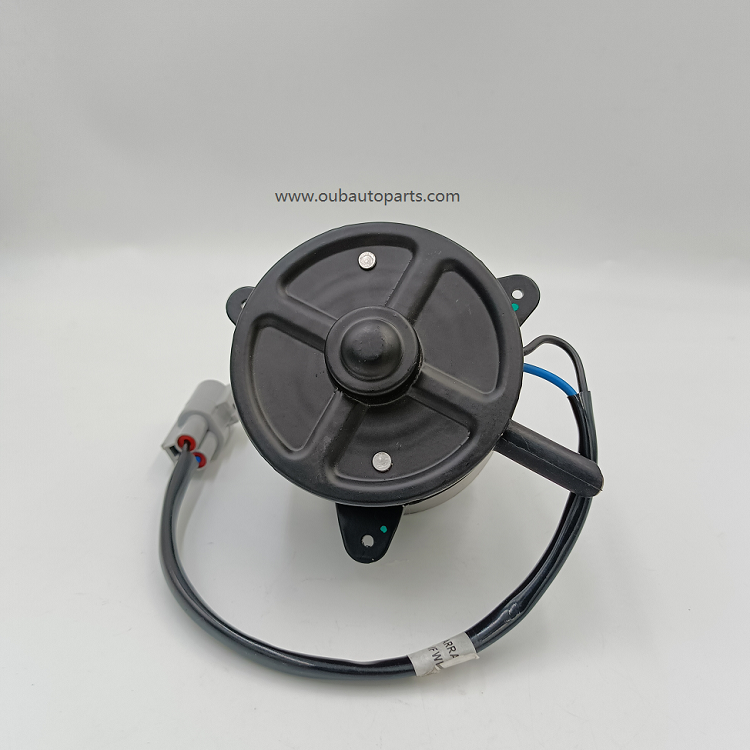
This is basically a 12v dc motor and only used on electric radiator fans. The purpose of the motor is to rotate the blades and cause them to move air. One of the features that vary with cooling fan motor designs is the size and shape. But in spite of these design differences, the motor contains the usual components.
A typical radiator fan motor consists of a housing, permanent magnets, armature and commutator held on a shaft, and brushes on an end plate. The assembly is then attached to the fan blade assembly and bolted to the fan frame for support.
During operating, the motor receives 12v via cables and connector. The resulting current energizes the coil on the armature, creating a magnetic field that acts against that of the permanent magnets. This causes the armature to rotate, thereby spinning the shaft. The shaft is connected to the blade assembly. Its rotation spins the blades.
Our Factory
Oubang automobile appliances co., ltd. Is manufacturer of cooling system parts fan motor since 1998, after more than 20 years of development and innovation, the company has developed four series of products and more than 500 hundred of varieties. The products are suitable for all kinds of japanese cars.


FAQ
As one of the leading toyota radiator fan motor manufacturers and suppliers in China for over 20 years, we warmly welcome you to buy or wholesale high quality toyota radiator fan motor at competitive price from our factory. For customized service, contact us now.
